In late 1951, officials of the State Fair of Texas paid $750 for a used Santa Claus. The figure stood 49 feet tall and had been built by the chamber of commerce in the small town of Kerens for the 1949 holiday season. The fair hauled it to Dallas, handed it to a local artist named Jack Bridges, and opened the 1952 season with a cowboy. That cowboy is Big Tex, and the odd economy of his origin says a good deal about the institution that owns him: a fair that has spent 140 years turning modest raw material into something Texans treat as permanent.
Two rival fairs and a merger
The fair began as a business venture with a rivalry built in. According to the Texas State Historical Association's Handbook of Texas, the Dallas State Fair and Exposition was chartered as a private corporation on January 30, 1886, organized by William H. Gaston, Thomas Marsalis, and John S. Armstrong. A competing group led by C. A. Keating chartered a second fair, the Texas State Fair and Exposition, set to open north of town one day before the Dallas event that October. The Handbook puts attendance at the Dallas fair that first year in excess of 100,000.
Two fairs in one city could not last. The associations merged in 1887 as the Texas State Fair and Dallas Exposition.
The decision that shaped everything after came in 1904. The fair association sold its grounds to the City of Dallas under an agreement that set aside a period each fall for the annual exposition. The fair's own history page notes that the association turned down offers from developers to make that deal. The arrangement explains why the fair still runs on public land owned by the city, and why the grounds became a civic park rather than a subdivision.
What the Centennial left behind
In 1934, Fair Park was picked as the central site for the celebration of a hundred years of Texas independence. The result was a $25 million rebuilding of the fairgrounds, and the Texas Centennial Exposition opened there on June 6, 1936. The Handbook of Texas describes it as fifty buildings billed as the first world's fair held in the Southwest. It ran until November 29 and drew 6,345,385 visitors in Dallas, a total the Handbook says fell short of expectations. The grounds reopened the next summer as the Greater Texas and Pan American Exposition.
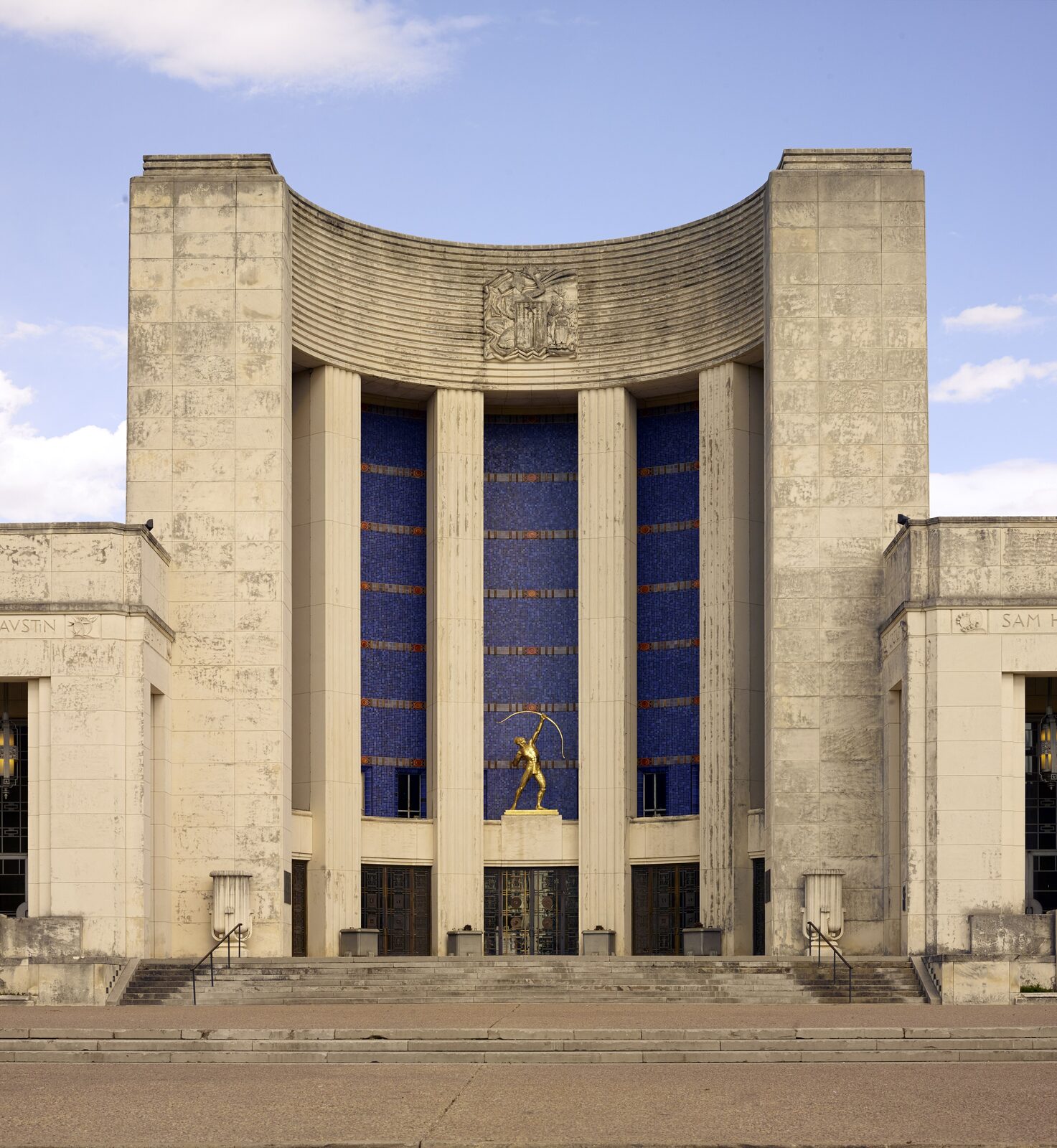
The crowds went home. The buildings stayed. George L. Dahl served as Centennial Architect, and the National Park Service documentation for the Texas Centennial Exposition Buildings describes an Art Deco ensemble of some 30 structures from the exposition era, calling Fair Park one of the largest intact groupings of exposition buildings remaining in the United States. The showpiece is the Hall of State, built as the State of Texas Building, which the same documentation singles out as an excellent example of Art Deco design. The Esplanade of State, the most formal axis in the park, runs from the Parry Avenue entrance toward it.
That inheritance gives the fair a setting few state fairs can match. Most fairgrounds are a collection of barns and exhibit halls built as needs arose. Fair Park is a planned 1930s exposition that a state fair happens to occupy every autumn.
From Santa Claus to cowboy
Bridges did more than repaint the Kerens figure. The fair's account says he slimmed the face and torso, gave the right eye a wink, and moved the right arm into a thumb in the vest pose. Big Tex debuted at the 1952 fair at 52 feet, standing in the median of the Court of Honor in size 70 boots and a 75 gallon hat. He later gained a voice, and by the middle of the decade he had moved to the roundabout in front of what was then the Federal Building, now the Tower Building, the spot he still holds.
For sixty years the figure held that post. Then, on October 19, 2012, an electrical short started a fire in his base. Dallas Fire Rescue responded, but the structure was destroyed while that year's fair was still underway.
The replacement was not a replica. The rebuilt Big Tex stands 55 feet tall, and the fair quotes Eddy Snell of SRO Associates, the firm that built him, observing that there is no manual for a cowboy that size. High winds pushed his unveiling a day early, and the fair held his welcome back celebration on September 27, 2013. His wardrobe has kept changing since: the fair partnered with Lucchese Bootmaker on a boot design contest, and for the 2019 winning design he wore size 96 boots.
A contest that turned frying into a sport
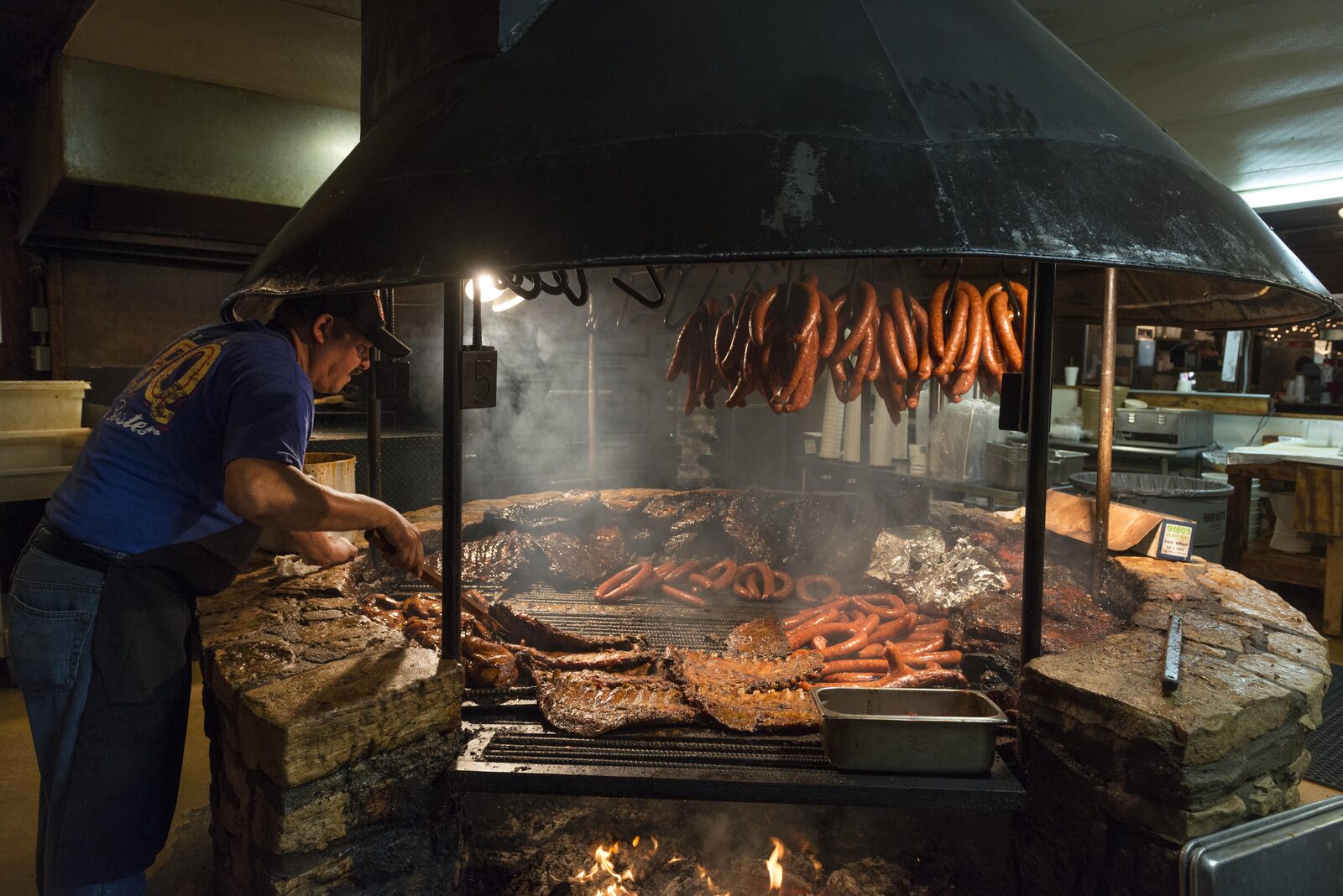
Fried food as a competition is newer than most visitors assume. The Big Tex Choice Awards began in 2005, according to the fair, and the contest quickly became the reason a certain kind of headline appears every September. Fried Coke took Most Creative in 2006. Deep Fried Butter won the same category in 2009, and Fried Beer followed in 2010. Fried Jell-O won Best Taste in 2016.
The format rewards invention as much as flavor. Entries are narrowed to a field of semifinalists and then finalists, and winners are named in Best Taste Savory, Best Taste Sweet, Best Taste Sipper, and Most Creative. The 2026 finalist list on the fair's site runs from nacho wings to a chocolate corny dog, which tells you the frying instinct now shares space with novelty of every sort. The contest works as free publicity for small vendors and as a reliable annual story for the fair, a partnership that suits both sides. Texas food traditions with deeper roots, like the ones traced in our guide to the state's regional barbecue styles, tend to resist that kind of yearly reinvention.
Who runs it, and for how long
The State Fair of Texas describes itself as a 501(c)(3) nonprofit organization, which is a different footing from the private corporation chartered in 1886. Its fair runs on land the city owns under the arrangement struck more than a century ago.
Length has grown along with the crowds. The fair says it extended its traditional season from 17 days to 24 in 1988, and the 2026 edition listed on its site runs from September 25 through October 18. Attendance history is long and well documented by the Handbook of Texas, which records the fair passing one million visitors in 1916 and three million for the first time in 1968. In 1986, when the fair combined its own centennial with the Texas Sesquicentennial, it drew 3,959,058 people, a total the Handbook describes as the largest attendance ever recorded at an American state fair.
Why the fair still matters to Dallas
A 24 day event on city land concentrates a season's worth of visitors into a single park, and the economics of that pattern are the kind we examine in our look at what growth means for a neighborhood. Seasonal crowds do not automatically translate into year round activity for the blocks around a park, and the question of what Fair Park does for its neighbors in the other eleven months is a fair one to ask.
The fair has also outlasted the state it was built for. The Texas described in our statewide demographic snapshot looks very little like the one that chartered two rival fairs in 1886. That the fair's best known symbol is a reworked Christmas decoration from a small town seems fitting. Much of what the culture section covers works the same way: borrowed parts, local hands, and a tradition that becomes real because people keep showing up for it.