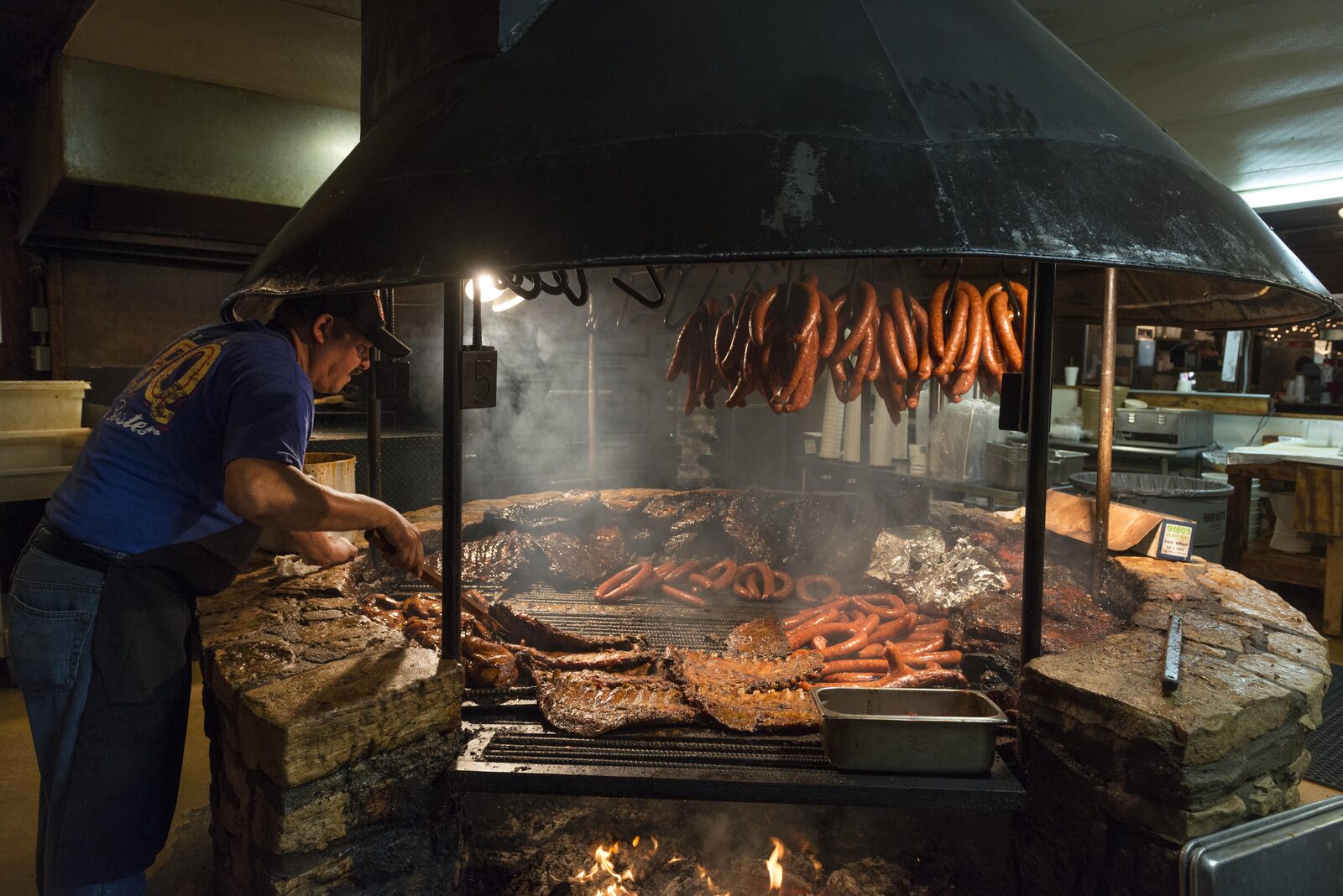
On a busy Saturday in 1999, the pit crew at Kreuz Market in Lockhart cooked a hundred beef shoulder clods and fifteen briskets. Roy Perez, who had worked those pits since 1987, wrote the numbers in his journal. When Texas Monthly checked back in 2023, a recent Saturday had run the other way: seventy briskets and twenty clods. The cut that now defines Texas barbecue took over its most storied pit within living memory.
Texas barbecue looks timeless, but it is several traditions that grew up in different parts of the state with different meat, wood, and fire. A 2013 essay by food writer Robert Moss, published by Texas Monthly, counted at least four: the Central Texas meat market style, East Texas chopped and sauced barbecue, South Texas barbacoa, and the West Texas cowboy style of cooking directly over coals.
The butcher shop behind the smokehouse
Central Texas barbecue began as a way for butchers to sell what they had not sold. The Handbook of Texas traces German immigration to the state back to the 1830s and describes a German Belt reaching from Galveston and Houston west to Kerrville, Mason, and Hondo. Czech settlers concentrated nearby, with Fayette County becoming the center of Czech population in Texas and Lavaca County close behind. In the prairie towns of that belt, the meat market was a fixture, and according to Texas Monthly the settlers who ran those markets in the late nineteenth and early twentieth centuries smoked their leftovers to sell on Saturday.
The records reach back a long way. Texas Monthly barbecue editor Daniel Vaughn notes that the first recorded mention of barbecue for sale to the public anywhere in the United States was an 1878 advertisement from a butcher in Bastrop. Southside Market opened in nearby Elgin in 1886, and the Handbook's entry on Elgin credits the town's hot sausage with a widespread reputation. In Lockhart, Jesse Swearingen opened a meat market in 1875, and Charles Kreuz bought it in 1900 for $200. A 1999 House resolution in the Texas Legislature named Lockhart the Barbecue Capital of Texas.
Why there were no forks
The way Central Texas barbecue is still served comes straight from the shop counter. Writing for Texas Monthly in April 1973, Griffin Smith Jr. described markets in towns like Lockhart, Taylor, and Luling where beef was barbecued in the back of the shop and handed over on red butcher paper. Sauce, if it existed, was a side dip. At many places there were no sandwiches at all, and customers could skip the bread and eat with their fingers, alongside onion, pickle, or a saltine.
Smith also offered a social explanation. The Saturday market barbecue, he argued, was built by people who could choose the better cuts and cook them for flavor, so strong sauces had little purpose. Kreuz Market turned that habit into doctrine. For more than a century the market made no forks and no sauce part of its identity, with a sign under the menu explaining that forks were at the end of your arm. The Lockhart location quietly began offering both in October 2017, after complaints from visiting diners who expected utensils, but the meat still arrives weighed and stacked on paper.
East Texas and the chopped sandwich
East of a line Smith drew from Columbus and Hearne north between Dallas and Fort Worth, the barbecue changes character. He described East Texas barbecue as usually chopped rather than sliced, made from pork as often as beef, and served on a bun with hot sauce. He placed it as an extension of the Southern barbecue found across the cotton states, and he wrote that its finest examples were in restaurants run by Black Texans.
Food historian Adrian Miller, interviewed by Texas Monthly in 2021 about his book Black Smoke, filled in the picture. Sauce, he found, was central to Black barbecue, often the marquee item in old advertisements. The core menu was spareribs, hot links, and chicken, with brisket less important. Patillo's in Beaumont, which Texas Monthly identifies as the oldest Black-owned barbecue restaurant in Texas, dates to 1912 and is known for the all-beef links of the Beaumont and Port Arthur region.
Barbacoa in the ground
South Texas barbacoa sits at the edge of the barbecue argument. In its classic form it means whole beef heads cooked overnight in an underground pit over wood coals. In 2013 Texas Monthly described a Brownsville shop whose sign advertised barbacoa in a hole with mesquite wood, where the heads were wrapped in foil and cooked through the night so that cheek, tongue, and the rest were ready before sunrise.
Texas Monthly has also said plainly that it treats barbacoa as its own category rather than as barbecue, because the smoke is incidental to the steam. That is a judgment about definitions, not quality, and it is one reason the magazine's 2013 Top 50 barbecue list left barbacoa off, as Moss pointed out in that same essay.
Fire straight under the meat
West of Austin, the cooking moves closer to the fire. The cowboy style puts meat on a grate directly over a bed of hot coals rather than in a chamber beside the firebox. A 2026 Texas Monthly profile of a joint in Mason that opened in 1953 describes mesquite burned down to coals in a separate pit, then loaded onto the firebrick floor beneath the meat, which the crew flips and moves by hand.
The most famous practitioner of the style, in Moss's telling, was Walter Jetton, who slow cooked whole steers over open pits for Lyndon B. Johnson and visiting dignitaries at the LBJ Ranch.
The wood you grew up with
The wood follows the map. Davey Griffin, a meat specialist with Texas A&M AgriLife Extension, told a 2018 South by Southwest audience that students favor the wood they grew up with: mesquite for those from South Texas, hickory for East Texans, and post oak for Central Texans. Mesquite also fuels the direct heat pits of the Hill Country. Wood preference, in other words, is regional identity, a pattern that tracks the divisions traced in our look at how Texas differs from region to region.
How brisket took the throne
For most of the twentieth century, Texas markets cooked whatever they could carve from the half carcasses the slaughterhouses delivered, which meant forequarter cuts such as chuck and shoulder clod. Louie Mueller Barbecue in Taylor did not add brisket until 1959. The change came in the 1960s, when the beef industry began shipping individual cuts in boxes. Pitmasters could buy only the cut they wanted, and Texas Monthly notes that brisket was among the best and most affordable choices.
The rise has kept going. A Fort Worth food distributor told Texas Monthly that demand for Prime grade brisket climbed sharply after 2013, and the magazine reports that many joints went from charging under $20 a pound to over $30 within five years. Brisket's dominance owes as much to industrial meatpacking as to any frontier tradition.
A map that is getting harder to read
Offset smokers now dominate new barbecue joints across the state, and Texas Monthly has recorded the closing of direct heat places in the Hill Country that are not being replaced. As small towns lose their old markets and cities absorb new residents from everywhere, a shift examined in our coverage of urban growth and rural sustainability, the styles are blending into a single statewide default built on Central Texas brisket. The older regional versions survive where families and crews choose to keep them, which makes them an ongoing decision rather than a fixed inheritance, the kind of local custom our culture coverage sets out to record while it is still being practiced.